
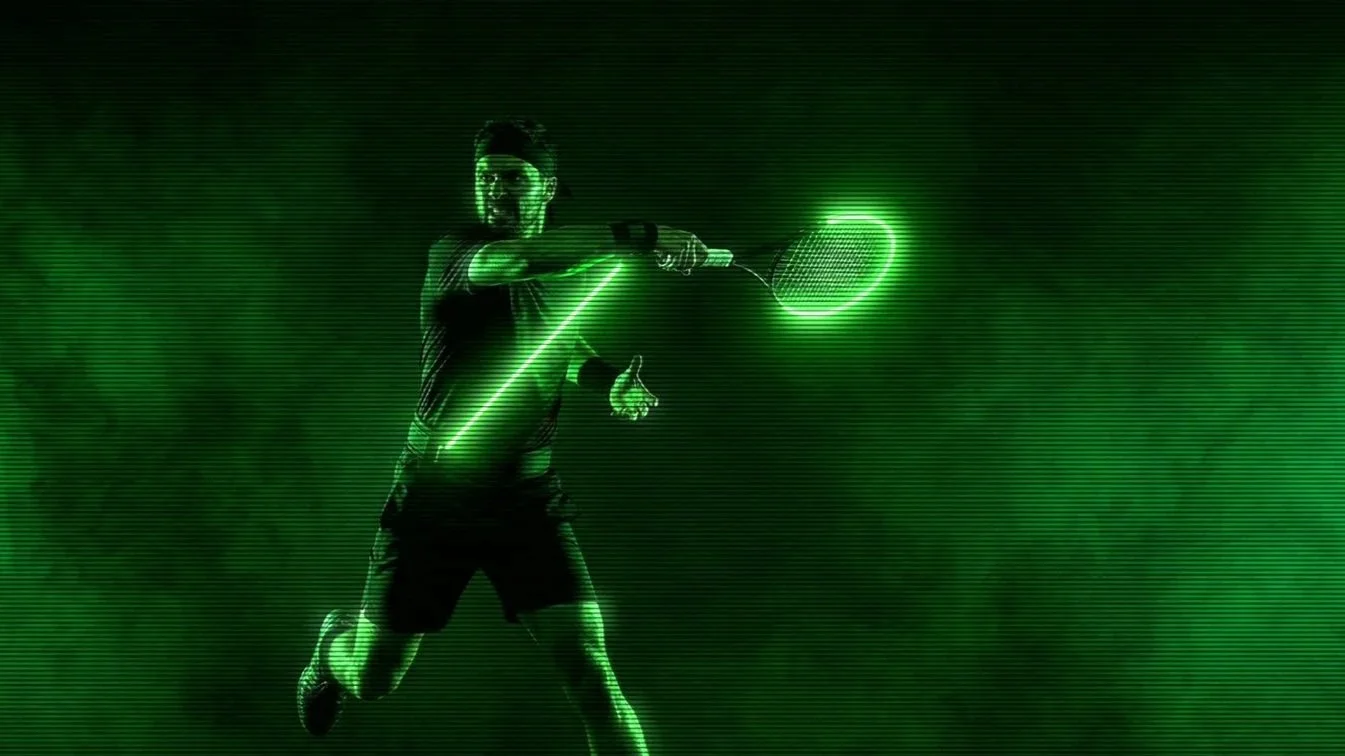

You are now equipped with the ultimate kinematic training system. This masterclass will guide you through precision setup and elite mechanical execution to unlock your maximum power, leverage, and topspin.
PROSTRAP TRAINING:
// ACTIVATE

1. ADJUST BELT
Calibrate the belt to your waist. It must be locked flush and secure to anchor your kinetic energy.
To disengage, pinch the quick-release tabs and depress the center lock.
2. LOCK THE PROCUFFS
First, slide on the moisture-wicking sweatband, followed by the wrist strap. Ensure a locked-in, slip-free fit to handle maximum torque.
3.ENGAGE THE RESISTANCE CORD
Snap the high-tensile cords into the tactical hooks on both the hips and wrists. You are now locked into the system.
CALIBRATING YOUR TENSION
Your system includes varied cord lengths tailored to your specific wingspan and biomechanics.
From shortest to longest: Yellow, Red, Blue, and Green.
There is no universal cord. Begin with the standard length for your tier and experiment to find the exact tension that forces elite extension without breaking your form.
The Prostrap is best used in specific training situations, ideally with a coach. You will get your best results using the Prostrap with:
A drop feed
a coach feed
a ball machine
The Prostrap is engineered for high-repetition, precision muscle-memory isolation. For maximum kinematic adaptation, train in controlled environments where the strike zone is absolute.
HOW TO TRAIN WITH
THE PROSTRAP
1. FEEL THE PULL
Pull the cord tight during the take back of the swing.
The hitting elbow should be away from the body, creating space for your swing
2. MAINTAIN TENSION
You MUST maintain the tension of the cord throughout the entire swing in order to use the Prostrap correctly.
By keeping the tension on the cord, the stretch of the cord forces you to create distance away from the body, putting your hitting arm in optimal position to create more leverage with your swing.

3. USE THE BODY
When done correctly, you should feel the hips and shoulders initiating the power behind the swing, as opposed to just the arm. The twist of the body is what should be creating power, not the hand and arm.
4. CREATE THE WAVE
As the cord is stretched to the end of the swing, its stretch will let you know where the follow through should wave both around and over the ball, creating natural brush and topspin.
Like the forehand, we’re trying to accomplish the same basic principles:
Pull the cord tight during the take back of the swing.
Maintain the tension throughout the entire swing.
However, there is one main difference between the forehand and the backhand:
When using the Prostrap on the two-handed backhand, size down to a smaller cord. This is due to having less range of motion as opposed to the forehand.
There are two ways to use the Prostrap with the two-handed backhand:
1. CORD ON THE DOMINANT ARM
The main focus with the cord on the dominant arm is the pull away from the body, creating space.
Feel the tension on the cord during the take back, focusing on the spacing.

2. CORD ON THE NON-DOMINANT ARM
You can also switch sides and use the cord on the non-dominant arm with the two-handed backhand. Both ways will help with both spacing and extension.
3. FOCUS ON EXTENSION
Unlike the forehand, on the backhand we want to go through the ball more as opposed to waving around it to create spin. By it’s nature, the two hander should have less spin than a forehand.
On the non-dominant arm, the focus should be on the extension out at the end of the swing, feeling the cord pull tight just before the follow through.
If you have any other questions, feel free to reach out via our contact page, or on social media. We’re happy to help and answer whatever questions you may have.